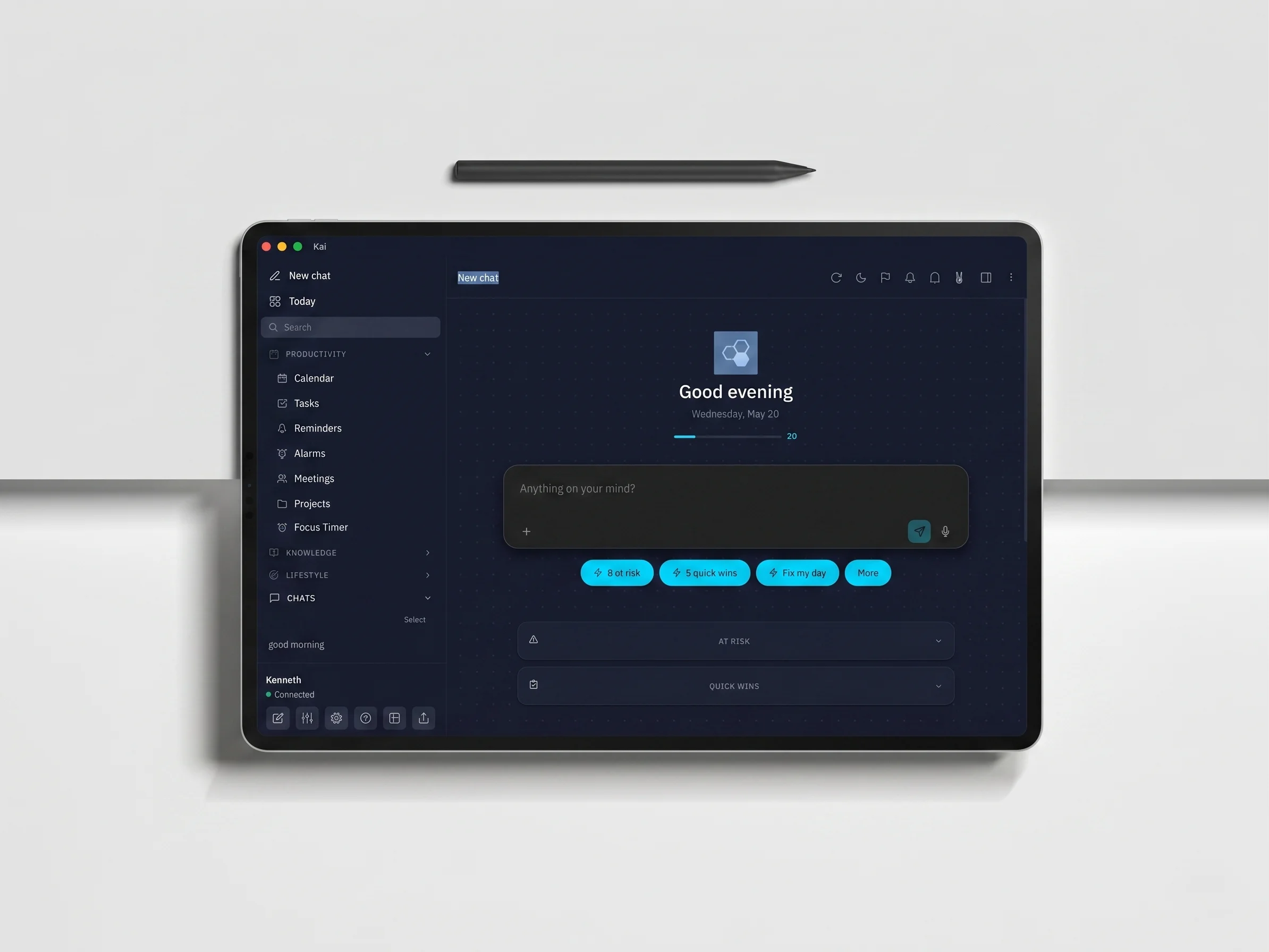
AI agents are software systems that autonomously plan, decide, and execute multi-step tasks — connecting to your existing tools, reading data, triggering actions, and adapting to outcomes in real time. Unlike traditional automation that follows fixed rules, AI agents handle ambiguity, make judgment calls, and escalate when needed. KAUFAST's New York team designs and builds production-grade AI agents for US businesses in customer support, sales, operations, and data workflows.
What Are AI Agents?
AI agents are autonomous software systems that use large language models to reason, plan, and take actions on behalf of your business. Unlike simple chatbots that follow scripts, agents can browse the web, call APIs, process documents, write code, and make decisions based on context. They integrate with your existing tools and handle multi-step workflows that previously required human oversight.
Businesses using AI agents report 40–70% reduction in manual task time.
Customer Support Agents
Autonomous agents that handle inbound queries, resolve tickets, and escalate intelligently — reducing support costs by up to 60%.
- GPT-4o
- Claude 4.5
- Zendesk API
Sales & Lead Agents
Qualify inbound leads, book discovery calls, and nurture prospects through multi-step sequences — without human intervention.
- LangGraph
- CRM integration
- Stripe
- Calendly
Operations Agents
Automate internal workflows: invoice processing, compliance monitoring, data extraction, and multi-system orchestration.
- n8n
- CrewAI
- AutoGen
- Zapier
Data & Reporting Agents
Agents that aggregate, analyze, and surface insights from multiple data sources — delivering dashboards and alerts automatically.
- LangChain
- Python
- GA4 API
- Looker Studio
HR & Recruiting Agents
Automate CV screening, candidate scoring, interview scheduling, and onboarding workflows — cutting time-to-hire by up to 40% for US companies.
- LangChain
- Workday API
- Gmail API
- PostgreSQL
E-commerce & Retail Agents
Handle product Q&A, abandoned cart recovery, return processing, and inventory alerts — fully integrated with your US store platform.
- Shopify API
- Claude 4.5
- Klaviyo

Why Businesses Deploy AI Agents
Discovery
We map your workflows, identify automation opportunities, and define the agent's decision boundaries and escalation paths.
- Workflow audit
- ROI modeling
- Data source mapping
- Risk assessment
Architecture
We design the agent system: LLM selection, memory strategy, tool integrations, and fallback logic.
- LLM selection
- Tool design
- Memory & context
- Human escalation paths
Build & Test
We build, evaluate, and red-team the agent before it touches production data.
- Agent development
- Evaluation suite
- Safety testing
- Staging environment
Deploy & Monitor
We launch with full observability — tracing every decision, measuring every outcome, iterating continuously.
- Production deployment
- Observability
- Performance dashboards
- On-call support

AI Agents vs Traditional Automation
| Capability | AI Agents | Rule-Based Bots | Manual Process |
|---|---|---|---|
| Handle ambiguity | Yes — reasons through context | No — fails on edge cases | Yes — but slow |
| Multi-step tasks | Plans and executes autonomously | Fixed sequences only | Requires oversight |
| Learning | Improves with feedback | Static rules | Depends on person |
| Integration | APIs, tools, databases | Limited connectors | Manual data entry |
| Cost at scale | Low marginal cost | Medium | High — linear with volume |
What is an AI agent?
An AI agent is software that can plan, decide, and execute multi-step tasks autonomously — unlike a chatbot that just answers questions. It can browse the web, call APIs, read documents, and trigger actions in other systems.
How is an AI agent different from a chatbot?
A chatbot responds to a single message. An AI agent executes a sequence of actions to achieve a goal — for example, receiving a support request, checking a database, drafting a response, escalating if needed, and logging the outcome.
How much does it cost to build an AI agent?
Scope determines cost. A focused automation — for example, a WhatsApp booking agent — typically runs $4,000–$10,000. A multi-agent system with complex integrations ranges from $20,000–$60,000. We scope every project in writing before development begins.
How long does it take to deploy an AI agent?
Focused agents ship in 2–4 weeks. Full multi-agent systems take 6–12 weeks from signed contract to production. Scoping adds 1–2 weeks at the start.
Which AI models do you use?
We select the right model for each task — GPT-4o for general-purpose agents, Claude 4.5 for document processing and nuanced reasoning, Gemini 2.5 for multimodal tasks. We build model-agnostic systems wherever possible to avoid vendor lock-in.
Can AI agents integrate with our existing tools?
Yes. We connect agents to CRMs (HubSpot, Salesforce), helpdesks (Zendesk, Intercom), databases, payment systems, email platforms, Slack, Teams, WhatsApp, and custom APIs. If it has an API, we can connect to it — including US-based platforms.
Do AI agents work in languages other than English?
Yes. We build multilingual agents that detect and respond in the user's language. We have active deployments handling English, Spanish, French, Portuguese, and more — with no extra configuration for end users.
How do you handle CCPA, HIPAA, and data privacy?
We design agents with privacy by default: no unnecessary data retention, encrypted storage, audit trails, and consent flows. For US healthcare clients, we build HIPAA-compliant systems. For California businesses, we support CCPA requirements.
What happens if an agent makes a mistake?
Every agent includes a human escalation path, a confidence threshold below which decisions are flagged for review, and a full audit trail. We run a red-teaming phase before production launch to surface failure modes before they reach real users.
Do we need an in-house technical team to run the agent?
No. We provide observability dashboards, automated alerts, and an on-call support package from our New York office. Most clients manage their agents through a simple admin interface — no code required after launch.
Ready to deploy AI agents for your business?
We design and build custom AI agents that integrate with your systems and handle real business logic. From customer support to internal operations.
Book a free consultationWe design and build digital products that move fast and feel right. Strategy, design, and engineering — under one roof.

Echoflicks

Hacienda de Samotracia

APM

Audra
Inmobi

SettleU

Insourceful

D-couple

KAUFAST